FUEL FLOW TRANSDUCERS

Specifications
Manuals
More Information
Purchase
FAQ's
Support Forum

Looking to upgrade your Fuel Flow Management system? We are now offering a Fuel Flow trade-in program.

Read More

Also offering package pricing on a complete Shadin Avionics Fuel Flow  system.


Shadin Avionics Fuel Flow Transducers

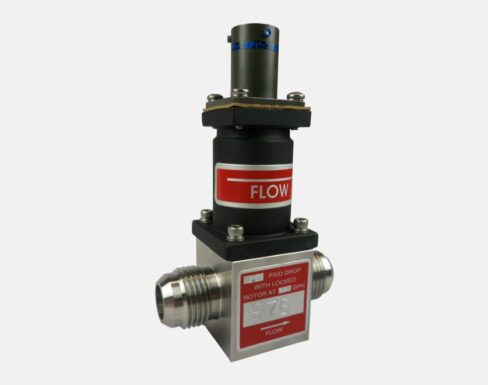
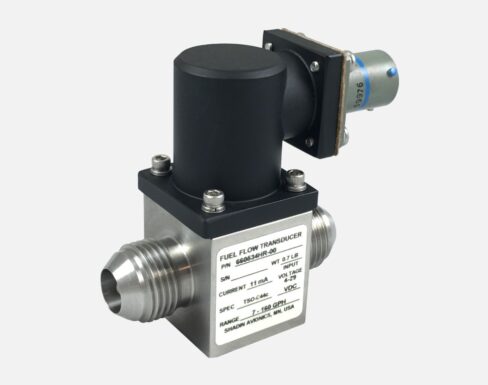
The transducer is a device that converts the mechanical motion of a spinning turbine into an electronic signal that is read by the fuel computer. The magnetic pick-up assembly detects the spinning turbine and counts the revolutions. This produces a series of pulses that is transmitted to the fuel computer. The computer uses the pulse frequency to calculate the fuel flow over time. The Shadin Avionics Company Incorporated-designed fuel flow transducer can be used in conjunction with all of our fuel totalizer units and fuel/airdata computers.

Shadin Avionics offers two types of fuel flow transducers that cover almost all General aviation and warbird aircraft. (Please refer to the installation STC approval list.)

    * Tangential flow transducers -- designed for reciprocating engines with low system pressure (up to 200psi) and fuel flow rates (up to 45gph). They require a stainless steel flame shield, sleeve, canister or box.
    * Axial flow transducers -- designed for turbine and large radial engines with high system pressure (up to 2000psi) and fuel flow (up to 450gph) applications. These transducers are made of stainless steel and meet all FAA requirements for installation in the engine compartment without additional heat or flame shielding. These transducers have excellent linearity and immunity from viscosity variation due to fuel temperature variation and low locked rotor pressure drop.

All hardware used in these assemblies, as well as the bracket to support them, is approved by the FAA under the PMA system.

General Description:


When the axially moving fluid hits the side of the stationary turbine blade it gets turned in a spiral motion and the fluid emerges from the turbine with a tangential velocity component. The reaction of this fluid on each turbine blade is a tangential force producing torque to turn the turbine in the opposite direction of the deflected flow.

For a given fuel flow the turbine will accelerate until it reaches such a rotational speed as to cause the fluid to meet the turbine blade point on. Under this condition, the fluid will cease to accelerate the turbine which will maintain a constant speed.

For a certain turbine the blade angle sets proportionality between axial flow velocity (flow) and tangential blade velocity (rotational speed) at which the turbine rotation will stabilize.

With the magnetic pick-up assembly detecting the turbine blade motion a pulse output at a frequency proportional to turbine speed will be produced.
Thus the pulse frequency produced by the turbine flow transducer is proportional to the flow rate. It is then used with electronic devices to calculate and display flow rates as well as flow volume over a period of time.

Effect of Friction:


The most significant friction effect is due to liquid viscosity. Both bearing friction and pick-up magnetic drag are comparatively small and are covered by calibration test runs.

Viscous friction tends to lower the rotational speed and hence the flow K-Factor, especially at low flow and high viscosity conditions.

The frequency of pulse rates generated at different flows ideally follows a straight line. Viscous friction causes deviation at low flow as shown.

The flow K-Factor plotted against the output pulse frequency divided by the kinematic viscosity (i.e. H/) gives the viscous performance curve, which will be fixed for a specific turbine regardless of what liquid was used.

The viscous performance curve is divided into three regions:

    * Viscous: The flow through turbine blades is laminar. The deviation of
      K-Factor from its ideal value is inversely proportional to H/.

    * Transient: The flow through turbine blades turns turbulent. K-Factor changes to its value for turbulent flow.

    * Turbulent: The flow through turbine blades is fully turbulent. K-Factor tends to be constant or slowly approaches the ideal value, depending on the smoothness of the flow passages.

Material Selection:

All the body components, including the flow straighteners and ball bearings, are made out of 303 stainless steel which has no magnetic properties but is ideal as far as the yield stress, high melting point and resistance to corrosion.

The turbine is made of a magnetic stainless material (14 pH) with a medium permeability number to facilitate disturbing the magnetic field.

The electronics body is made of carbon steel to act as a shield from any external magnetic field generated by the aircraft electrical systems.

Shadin Transducer Part Number Chart


Part Number
Flow Range
(GPH)
K-Factor
(PPG)
Pressure Drop
(PSI)
Rotor Locked at
(GPH)
Flare Fittings
660526
7-70
42
6.0 Jet A-1
5.0 AvGas
70
-8
660526A
7-70
42
6.0 Jet A-1
5.0 AvGas
70
-8
660527
45-450
5.8
6.2 Jet A-1
450
-10
660532
10-200
9.6
3.5 Jet A-1
200
-10
660534
10-160
20
6.5 Jet A-1
5.5 AvGas
160
-8
660535
7.5-100
24
5.0 Jet A-1
4.3 AvGas
100
-10
660537
15-350
7.8
6.0 Jet A-1
5.3 AvGas
350
-10

Other Fuel Management Products


DIGIFLO-L


MINIFLO-L


DIGIDATA


MICROFLO-L
Shadin Avionics Service Center
6831 Oxford Street
St Louis Park, MN  55426
service@shadin.com
1.800.328.0584 or 1.952.927.6500

Quick Links